
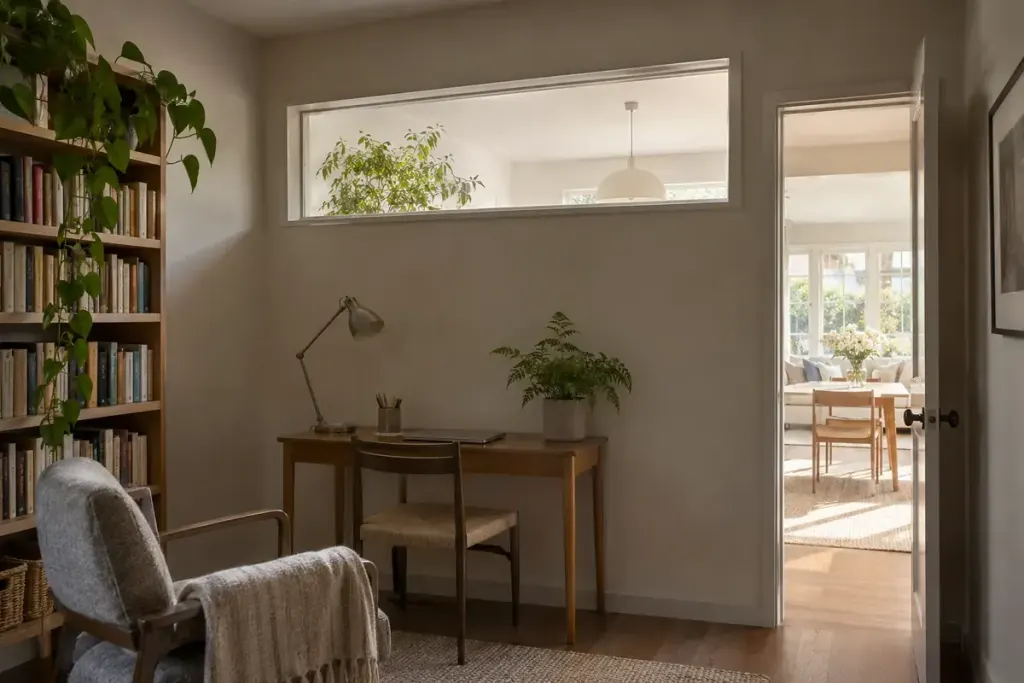
The room looks bright in the viewing photograph, yet its light enters through another room. This is often described as borrowed light: an internal window, glazed door or opening lets light travel beyond the space with the external window. It can be an attractive design feature, provided it suits the way you will use both rooms.
Trace the light back to its source
Stand where the desk, sofa or bed would actually go. Identify the outside window supplying the daylight and everything between it and your position. A curtain in the neighbouring room, a closed door or a future bookcase may change the result. Ask whether the photograph was taken with electric lights on.
Try a simple viewing exercise. With permission, look at the room in its ordinary daytime arrangement, then with the neighbouring space set up for privacy. Record what changes. You are testing a daily routine, not trying to prove that an internal opening is a defect.
Two rooms share the decision
Imagine one person working late while another wants darkness. Will the internal glazing carry artificial light between them? Is there a blind, and can it be operated from the room that needs control? If you propose adding one, check how it will fit rather than assuming there is a suitable fixing surface.
Sound, ventilation and permitted room use need separate questions. Light passing through glass does not establish that fresh air can enter, that speech will remain private or that a room qualifies legally as a bedroom. Ask the relevant local professional about the property’s documentation and applicable requirements; a photograph cannot settle those issues.
A useful viewing note might read: “Daytime reading works near the internal window; privacy blind reduces the light; evening lamp shines into the hall.” That is more actionable than simply writing “bright.” It helps you compare the room with your actual needs and gives an inspector or designer a precise point to investigate before you commit.