
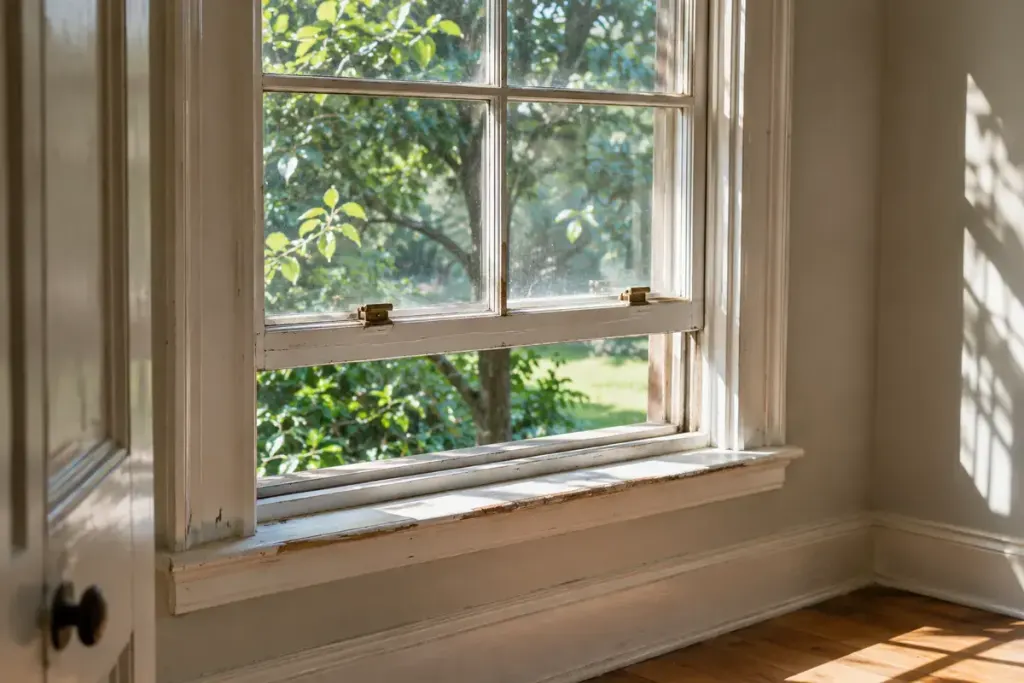
A freshly painted sash window can look convincing in a property photograph while telling you very little about how it works. At a viewing, the useful question is whether the moving parts operate safely and whether the seller can explain the repair history.
With permission, ask the agent or owner to demonstrate the window. Do not force a sash that is stuck, and do not put your fingers beneath one that may fall. Some traditional sash windows use cords and counterweights; others use different balance systems. Appearance alone will not identify every mechanism.
Watch one complete opening cycle
Does the sash move smoothly, stay where it is placed and meet the other sash properly when closed? Note a dropped side, a sash that will not stay up, paint bridging a joint, or a lock that only aligns when someone pushes hard. These are observations for further investigation, not proof of a particular repair bill.
Look at the surrounding timber and sill as well as the glass. Photograph the whole window, then any detail the seller permits you to record. Label the room so that a later question does not become “the difficult window somewhere upstairs”.
Historic England’s window guidance explains that traditional timber windows can often be repaired and that individual sashes may be removable for repair. Replacement should therefore not be assumed from a single stiff movement.
Ask for the explanation and the paperwork
Useful questions include when cords or balances were serviced, whether glazing was changed, and who completed the work. Heavier replacement glazing may affect the balancing arrangement. In a protected building, also establish which permissions apply locally before planning alterations.
For your viewing notes, use a plain entry such as “front bedroom: lower sash demonstrated, drifts down when released; seller says cord repair pending”. That gives a surveyor something specific to examine. It is much more actionable than deciding, on the spot, that all the windows are either original treasures or beyond saving.