
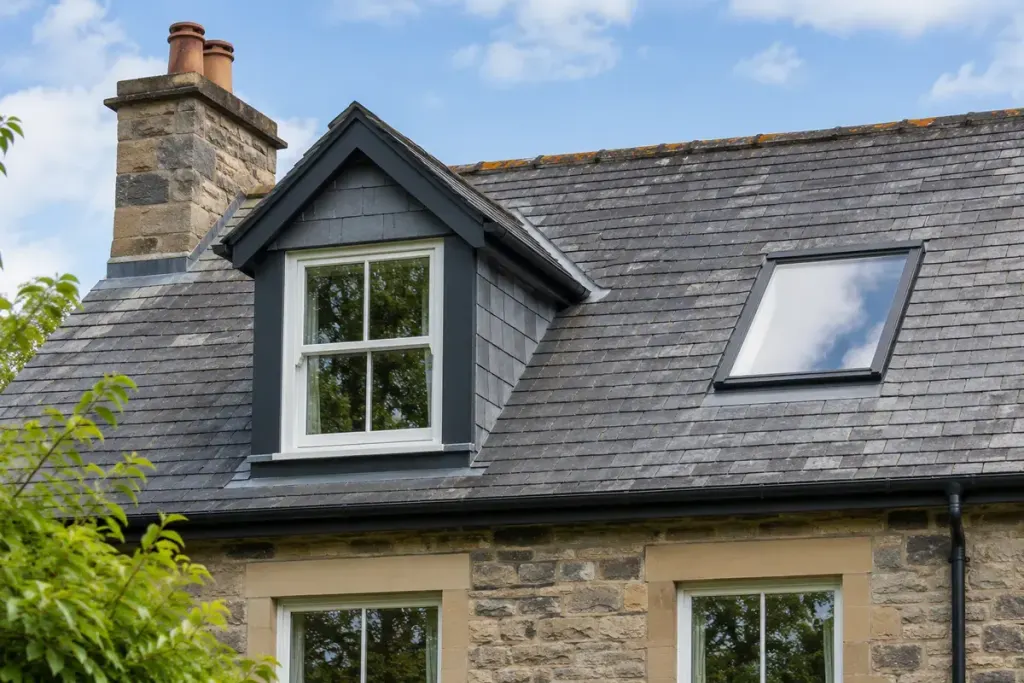
Two attic rooms can receive daylight through very different openings. One has a window in a small structure projecting from the roof; the other has glazing set into the roof slope itself. Calling both “attic windows” misses useful details about how they are used and maintained.
A dormer has its own roof and side walls, often called cheeks, around the window. A rooflight generally follows the plane of the main roof. Historic England’s dormer guidance describes the parts of these projecting structures, including variations in their construction.
Ask for an opening demonstration
During a viewing, ask the owner or agent to show how the window operates. Where is the handle? Is there a remote control, restrictor or other mechanism? Can the intended user reach it comfortably? Observe the demonstration without forcing an unfamiliar fitting.
Check the blind or shading arrangement at the same time. A window can be attractive in a photograph while its handle, blind and furniture compete for the same space. Record the model if a replacement part or operating instruction might be needed.
Consider the route for maintenance
Ask how the outside glazing is cleaned and whether the manufacturer provides an indoor cleaning position. Do not lean out or enter a roof to investigate. A high or awkward opening may need professional access, which belongs in a realistic maintenance plan.
A dormer also has junctions where its roof and cheeks meet the main roof. Ask a surveyor which areas were visible and whether any require further assessment. The architectural label cannot establish the condition of flashing, insulation or concealed structure.
Keep alteration questions tied to the property
If the opening was added or replaced, request the available installation, warranty and approval records. Historic England’s loft-conversion advice is useful background for historic buildings; local requirements govern an actual property elsewhere.
A good viewing note can be compact: window type, opening method, cleaning arrangement and unresolved inspection question. Those details describe the feature you will live with, rather than relying on a bright photograph to answer every practical concern.