
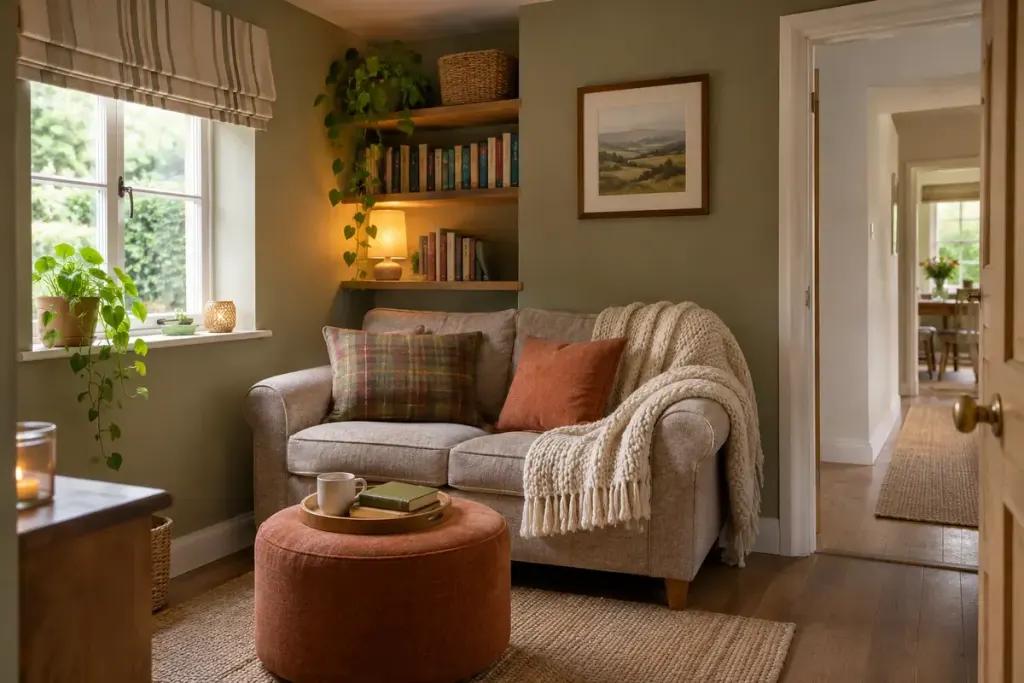
“Snug” is an inviting word in a property listing. It often suggests a smaller, comfortable sitting room, but it is not enough information to decide how the space will work in your household. Treat it as the beginning of a viewing question rather than a promise about size or suitability.
A photograph may show an armchair and a lamp while leaving out the doorway, the route to another room or the only place a radiator can sit. The most useful inspection starts with ordinary movement: enter, close the door if there is one, and trace how people would use the room.
Give the room a job before measuring it
Choose a realistic use to test. Reading alone, watching television with two people and making a private work call create different requirements. A small room can perform one of those jobs well without performing all three.
- Measure the usable wall lengths around doors, windows and fixed fittings.
- Check whether seating would obstruct the entrance or a through-route.
- Notice the position of sockets, heating and any existing ventilation.
- Look at daylight and the view from a seated position, not only while standing in the doorway.
- Listen with the adjoining room in use if the viewing allows it.
Bring the dimensions of the furniture you intend to keep. In a fictional example, a room can accommodate a two-metre sofa against one wall but leave too little space for a door to open comfortably. The sofa fitting into the rectangle does not mean the arrangement works.
Keep a sitting-room label separate from another intended use
If you want to use the space as a bedroom, ask about the relevant permissions, safety requirements and practical conditions for that use. Do not infer that a marketing name or the presence of a daybed establishes compliance. Local rules and the property’s circumstances matter.
After the visit, write one sentence describing the room’s strongest role and one describing its main limitation. “Good for one person’s reading, with borrowed light and regular through-traffic” is more useful than copying “charming snug” into your notes. It also helps you compare two homes without letting the most appealing room name win the decision.