
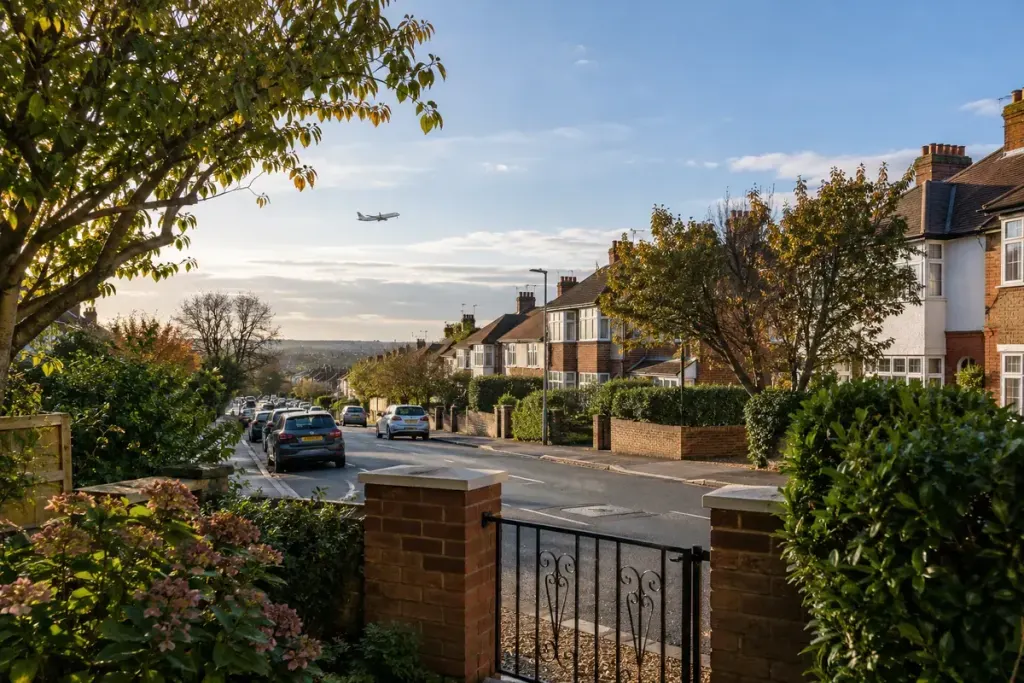
A property can sit outside a prominent airport-noise contour and still experience clearly audible aircraft. The contour answers a defined measurement question. It does not promise that a garden, bedroom or video meeting will be quiet at every hour.
Read the metric before reading the boundary
The US Federal Aviation Administration explains that Day-Night Average Sound Level, or DNL, combines aircraft sound exposure over a day and gives additional weighting to nighttime operations. Airport assessments commonly use an annual average day. That is different from the maximum level or timing of one flight.
Imagine two viewing appointments at the same house: one during a quiet interval and another while a series of aircraft passes overhead. Neither short visit, by itself, describes the annual pattern. Equally, the annual metric does not tell you exactly how that second appointment will feel.
Turn the map into more specific questions
- Which year, airport scenario and metric does the map represent?
- Are the contours based on existing operations or a proposed future arrangement?
- Where are the relevant flight paths, and what makes their use vary?
- Does the airport publish monitoring information or an explanation of local operations?
Use the airport’s and planning authority’s current material rather than an unlabelled image copied into a property listing. A boundary without a legend, date or scenario is not enough to support a comparison between homes.
At the property, listen from the spaces that matter to your routine: the intended bedroom, a home-working room and any outdoor seating area. Note whether windows are open, what else is audible and the approximate time. A phone sound-meter app can be an informal observation aid, but it is not a substitute for a professional assessment.
If noise is central to the purchase decision, obtain appropriate local advice and ask about relevant disclosures and planned operational changes. Treat a quiet viewing and a reassuring map as pieces of evidence to examine together. Neither should be made to answer a more precise question than it was designed to address.